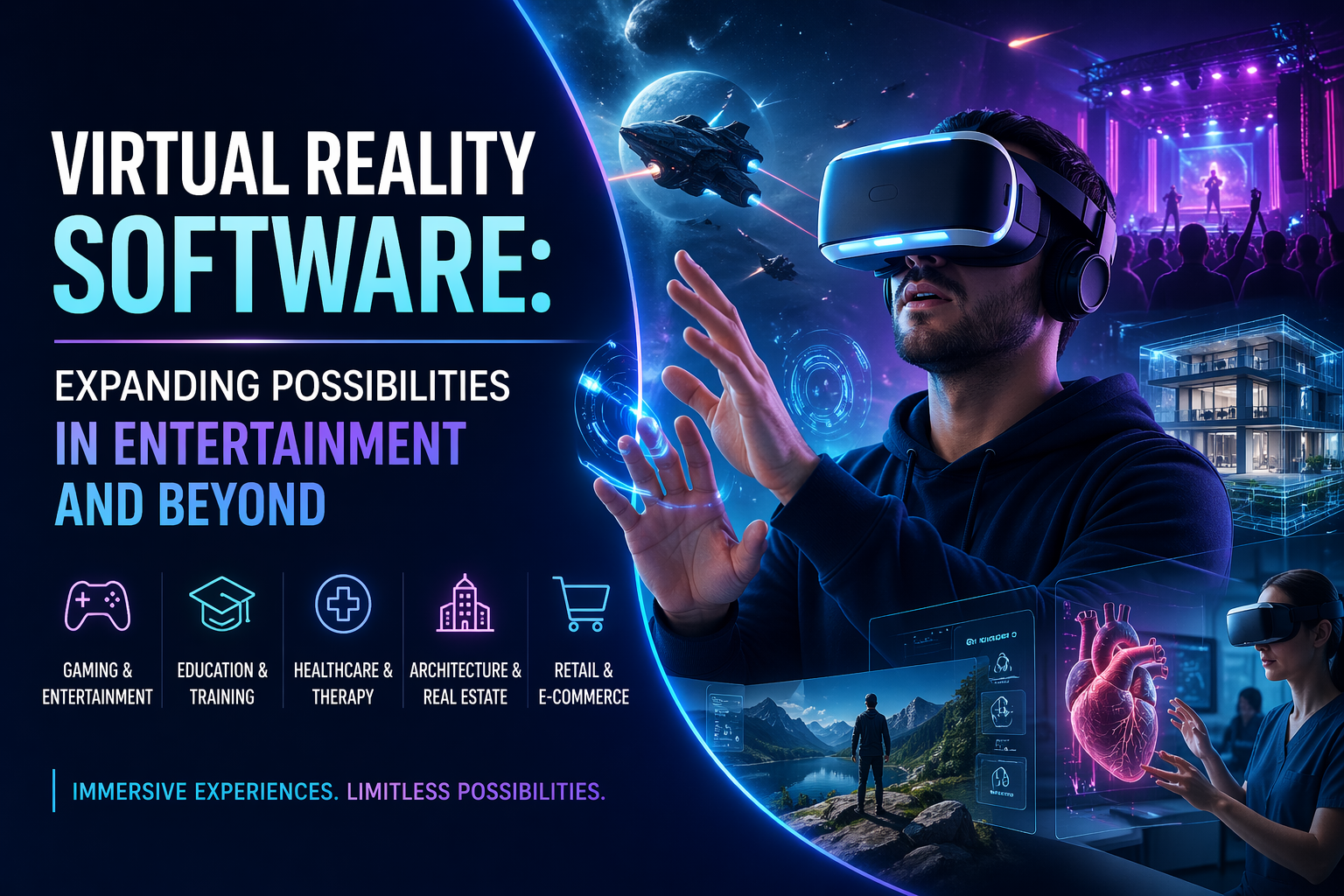
Virtual Reality Software: Beyond Immersion, Toward Real Business Impact
Virtual Reality (VR) is no longer just about futuristic gaming or flashy demos. Today, it has evolved into a serious software ecosystem that is reshaping how businesses train, design, sell, and collaborate. Instead of asking “What is VR?”, the better question now is: how can VR software create measurable value?
This article takes a practical, modern view of virtual reality software—focusing on how it works, where it delivers real results, and why it matters for companies moving toward digital transformation.
What Makes VR Software Different?
Unlike traditional applications, VR software is built to simulate environments that users can interact with in three dimensions. These environments are designed to feel real, not just look real.
At its core, VR software combines:
- 3D simulation engines
- Real-time interaction systems
- Sensory feedback (visual, audio, sometimes haptic)
This creates immersive experiences where users don’t just observe—they participate.
Modern VR platforms often rely on engines like Unity or Unreal Engine, going through stages such as planning, development, testing, and deployment like any software product :contentReference[oaicite:0]{index=0}.
Why VR Software Is Growing Fast
The rapid growth of VR software isn’t accidental. Businesses are adopting it because it solves problems that traditional interfaces cannot.
For example:
- It reduces risk in training environments
- It allows virtual prototyping before production
- It improves customer engagement through immersive experiences
The global VR market is expected to continue expanding significantly, driven by demand across industries :contentReference[oaicite:1]{index=1}.
Key Use Cases That Actually Matter
1. Training Without Real-World Risk
Companies use VR software to simulate dangerous or complex environments—like factories, medical procedures, or aviation training.
This allows employees to practice repeatedly without real-world consequences, improving safety and knowledge retention :contentReference[oaicite:2]{index=2}.
2. Product Design & Prototyping
Instead of building expensive physical prototypes, teams can test ideas inside virtual environments. Designers can iterate faster, identify issues early, and reduce development costs.
3. Immersive Marketing & Sales
VR lets customers experience products before buying—whether it’s exploring a hotel room or customizing furniture in a virtual space :contentReference[oaicite:3]{index=3}.
4. Remote Collaboration
Teams can meet inside shared virtual environments, making remote work more interactive than video calls. This is especially useful for global teams working on spatial or design-heavy projects.
5. Education & Simulation
From medical training to virtual classrooms, VR software enables learning by doing—one of the most effective ways to retain knowledge.
Core Components of VR Software
To understand how VR applications are built, it helps to break them into components:
- Rendering Engine: Generates real-time 3D visuals
- Interaction System: Tracks user movement and input
- Content Layer: The actual virtual environment and assets
- Hardware Integration: Connects software to headsets and sensors
These elements work together to create the illusion of presence inside a digital world.
Challenges You Shouldn’t Ignore
Despite its potential, VR software isn’t without limitations:
- High development cost: Building immersive experiences requires specialized skills
- Hardware dependency: Not all users have access to VR devices
- User comfort: Motion sickness and fatigue can affect adoption
- Performance demands: Real-time rendering requires powerful systems
Companies need to align VR implementation with clear business goals to justify the investment.
The Future: From VR to Spatial Computing
VR software is rapidly evolving into a broader concept known as spatial computing—where digital and physical worlds blend seamlessly.
Future trends include:
- Lightweight or headset-free VR experiences
- AI-driven virtual environments
- More realistic sensory feedback (touch, sound, even smell)
As the technology matures, the focus will shift from novelty to necessity.
Final Thoughts
Virtual reality software is no longer just an experimental technology—it’s becoming a strategic tool for innovation.
Organizations that understand how to use VR effectively will gain advantages in training, design, customer experience, and collaboration.
Instead of asking whether VR is the future, the real question is: how soon will your business start using it?